|
Welcome to Points of Issue Books
Today's Most Popular Books | 
| 
| 
| 
| 
| 
| 
| 
| 
| 
| 
| 
|
|
|
|
How can POIBooks.com help you?
This website helps you research first edition books. It provides search links to help you locate unique first edition points of issue for hundreds of books. Whether you have found a book and want to establish its value, or you are looking to purchase a first edition book online, this site can help you find examples of what a particular first edition book looks like as a point of reference, so you can determine whether yours is a first.
What books are collectible?
Books that are considered important are the ones most collected. Important books are those that have influenced our history and society in a significant way. Examples include modern classics such as A Catcher in the Rye or To Kill a Mockingbird because these novels helped changed our standards for literature. Other examples include books that changed our societal thinking such as Rachel Carson’s Silent Spring or Doctor Spock’s The Common Sense Book of Baby and Child Care. There are also books that appeal to multiple groups of collectors such as Malamud’s The Natural, which is collectible as both a literary work and a piece of sports memorabilia.
What’s the difference between a rare first edition collectible book and a common later printing?
Generally speaking collectors are looking for the first printing of a first edition book. There are usually subtle, but important features that distinguish a rare first edition from a common reprint. These features are called “points of issue”, and they are specific to each individual book. Points of issue describe details about what a book looked like when it was first published. Points Of issue can describe a book’s binding, a specific first printing typo, or a review that can only be found on the first printing dust jacket.
The most common point of issue can be found on a book’s copyright page. The copyright page may say that a book is a first edition, or a first printing, or first impression; and it may state additional printing information, or it may provide a printing code indicating what printing a book is from. But there are no hard and fast rules. Each publisher has used various methods over the years to indicate a book’s edition and printing. This website helps you find photos of first edition copyright pages to help you establish if yours is a true first.
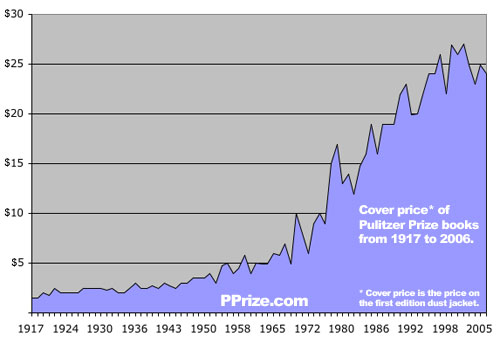
Another common point of issue is a book’s cover price which is typically printed on the dust jacket. The cover price is something that publishers are forced to change to keep up with inflation. So even when publishers try to preserve in subsequent printings the same original artwork, reviews, and author information, they typically change the price. Consequently, the price is a key indicator that a dust jacket is the original companion to a book. For example if the book is a first edition from the 1950’s and the price on the dust jacket says $9.95, then you should be suspicous because the price is too high given the time period. In such a case the dust jacket was likely taken from a later printing and married to the first edition book. The chart on the right shows cover prices for Pulitzer Prize winning books from 1917 to the present. This chart is helpful in giving you a ball park idea of what the price should say on a dust jacket from a particular publication year.
The presence of a price on a dust jacket is also the most fundamental way to ensure that the dust jacket is not from a book club edition. Book club editions look similar to genuine first editions, but they are not first editions, and they have very little collectible value. One key indicator of a book club edition is that it lacks a price on the dust jacket, and a dust jacket with the corner clipped where the price should be deserves some scrutiny. The dust jacket could be clipped because the book was given as a present at some point in its lineage, or it could have been clipped as part of a markdown process during a book sale. But it is also likely that the jacket was clipped to hide the fact that it was from a book club edition. In some cases there are other ways to determine if a clipped jacket is genuine. Sometimes the book club jacket will have some additional small print on it, and new jackets have a price code in the bar code field on the back panel that mirrors the price on the inside flap.
As for the book itself, there are points of issue that help you tell the difference between a first edition book and it’s book club counterpart. Book club books tend to be made from cheaper materials. Sometimes this means that the book club edition will have solid black paper boards while the true first edition has colored boards with a cloth spine. Sometimes the book club book is smaller than the true first. Other times the book club edition might not state “first edition”, while at other times it might and instead have a small circle or square blindstamp on the back outside cover near the spine.
All of these factors underscore the importance that points of issue are unique to a particular book. To search these specific points of issue simply type in the name of a book, or the name of an author in the fields above; or browse all of our points of issue by clicking on the bars below.
|
|
Browse by Author
Browse by Decade
|